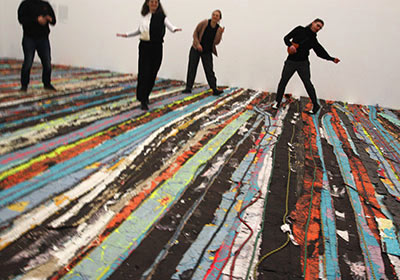
Educational experiment in the exhibition "Keep Walking" by Mark Bradford, Hamburger Bahnhof – Museum für Gegenwart
Access to art: opening exhibitions.
Seminar and Practice (MA), Institute for
Art Didactics and Aesthetic Education, UdK Berlin, winter term 2024/25
This seminar moved through exhibitions in different locations (e.g. in a project space, a community gallery or a public museum). We approached the exhibitions on site and analysed their staging, statements and addresses. The institutional framework was reflected on and the accessibility of these spaces for working with different groups was tested.
Theoretical and practical examples of art education as well as readings on exhibition analyses as well as on exclusions and approaches in the art context offered assistance. In a subsequent step, concrete ideas for improving or supplementing individual exhibitions or rooms were developed.
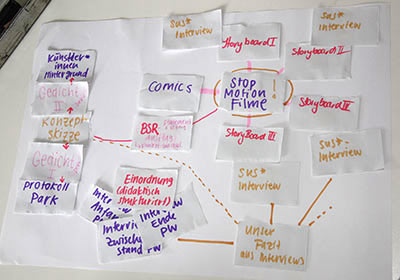
Paper sketch of the website of the project "Up close: between sensing and storing"
Sustainable Digital Storytelling.
Practical Seminar (MA) with Brendan Howell, Institute for
Art Didactics and Aesthetic Education, UdK Berlin, winter term 2023/24
In this teaching cooperation between Brendan Howell, artist and reluctant engineer, and Nanna Lüth, artist and headstrong didactic, we worked with materials from the seminars "Research with pupils (on the topic of climate change)", since winter 2324, some of which are being developed in parallel. The docents taught how online stories about artistic climate education can be told in a playful way with simple means and taking into account the environment.
The aim was to create a platform that would support the accompanying research on and the project "Schools of Sustainability. Agency instead of powerlessness", a cooperation between the Haus der Kulturen der Welt (HKW), artists, Berlin schools and the Berlin University of the Arts (UdK). The website, programmed by hand by the students, is called: storiesofsustainability.de
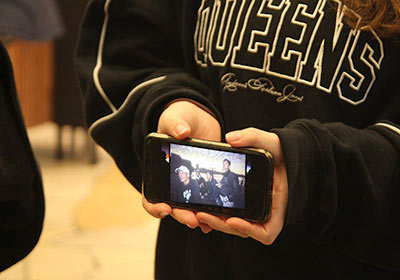
Collecting pictures in the exhibition "Dream on – Berlin, the 90s"
Reflexive of differences: Photography in the classroom.
Seminar and Practice (MA), Institute for
Art Didactics and Aesthetic Education, UdK Berlin, winter term 2023/24
This event was about overcoming the difficulty of photographing people and situations without using clichés and stereotypes. For this purpose, the seminar participants first started their own photographic productions. Interim results and approaches were discussed. The practice was accompanied by reflection on one's own experiences with the photographic medium and the discussion of didactic, educational and cultural texts.
Based on these foundations, photo didactic concepts were developed and implemented in cooperation with the teacher Alexander Di Vasos in a basic art course at the Otto-Nagel-Gymnasium, Biesdorf. In the exhibition "Dream on - Berlin, the 90s" at c/o Berlin, the pupils of the course looked for suggestions for their own photographic projects.
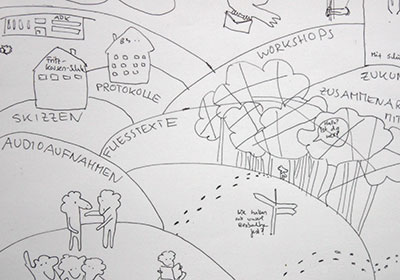
Hannah Haendschke: „Where do we stand with the research?“, map (detail), 2024
Seminar and Practice (MA), Institute for Art Didactics and Aesthetic Education, UdK Berlin, winter term 2023/24
The event "Research with students (on the topic of climate change)" arose from the request to accompany art projects on the topic of climate crisis and climate feelings at three schools, i.e. the Fritz Karsen School in Britz, the Evangelische Schule Berlin Mitte and the Dietrich Bonhoeffer Elementary School in Charlottenburg. The challenge was to work out methodological foundations with a small group of students and to make participatory observations in time for the start of the project in November. Selected literature on climate change education and empirical methods of observation, interviewing and mapping accompanied the first school visits. As part of the artistic-scientific field research, sketches, photographs, audio recordings and texts were produced in various formats.Towards the end of the semester, we recorded the status of our research in a map that will support other students in the continuation of the project in the coming semester (see figure).
Berlin University of the Arts in cooperation with the project "Schools of Sustainability. Power of action instead of powerlessness" by the Haus der Kulturen der Welt (HKW) and three Berlin schools, funded by the Senate Department for Mobility, Transport, Climate Protection and the Environment.
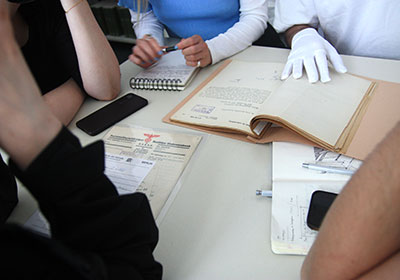
Students conduct research in the university's archive.
Seminar and Practice (MA), Institute for Art Didactics and Aesthetic Education, UdK Berlin, summer term 2023
Parallel to the lecture series entitled "Art/Education in National Socialism. Review, Continuities, Perspectives", an exercise in the research module for Master's students of the Art Teacher Training Programme took place at the UdK Berlin in the summer of 2023. With the support of the head of the archive, Dietmar Schenk, they were given an insight into the work in the university archive (see illustration).
After reviewing the catalogue, the students worked in groups to pursue their own questions and interests. The research sketches developed in this way and with suitable method modules recorded the first steps in the independent examination of original documents. The participants deepened their insights and questions in the form of a term paper. About half of the topics chosen for these papers relate to historical events documented in the UdK archive or in other sources. The other half deals with how the described retrospective can be used today for art lessons and exhibition mediation.
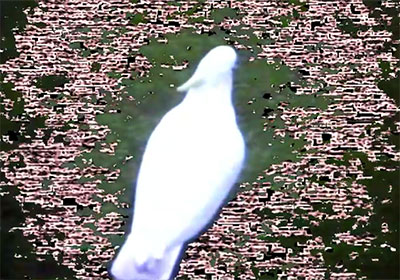
Michelle Marx: On my own track 1998 (video still), 2023
on your own track. #biographize critical diversity .
Interfaculty Seminar (MA), Institute for Art in Context/Institute for Music Education/Studium Generale, UdK Berlin, summer term 2023
Together with the music educator Isabelle Heiss, I wanted to offer the space in this seminar to deal with the role of music in biographies, i.e. in one's own and those of fellow students. For this purpose, we worked with audio samples, readings and "memory works" according to Frigga Haug, which stand for a writing technique and a research approach at the same time. In order to reflect on the different experiences and perspectives in their institutional framework, we also looked at the Critical Diversity Policy of the UdK Berlin (2022). This concept paper for anti-discrimination and diversity is intended to identify and dismantle barriers, disadvantages and discrimination in all areas of the university. It was enriched and contrasted with the personal experiences of the seminar group, which ranged from individual lessons on the piano to making exhibitions in a media art class. The intensive interdisciplinary exchange between and with the students and individual reflections outside the seminar time were logged in learning diaries in different media. At the end of the semester, the students put together excerpts for submission. Among other things, an analogue playlist in a cassette cover and an experimental video (see illustration) were created.
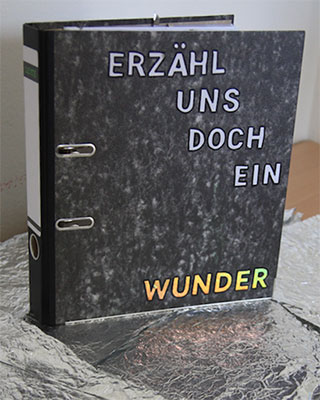
Collection of miracle documentation
Seminar (MA), Theatre Education, UdK Berlin, winter term 2022/23
This interactive seminar gave an insight into theatre pedagogical positions and didactic approaches. In addition to some basic terms and methods, we dealt with current issues such as theatre education in the migration society, feminist and inclusive theatre education. Exemplary texts were presented and discussed in the form of experimental group presentations. For example, a text about the Fundus Theater served as a springboard for a search for miracles followed by a miracle exhibition in a miracle folder (see illustration). The everyday miracle of a soda dispenser was filed here as well as the wondrous variety of male namesakes in and around the university building.
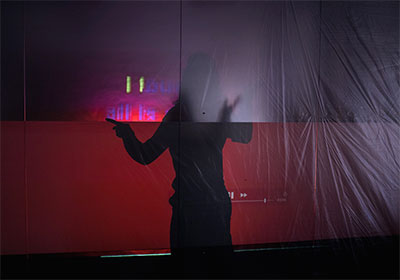
Fenia Franz: Your body, my temple, baby (Karaoke), 2023; Photo: Jana Kießer
Seminar (MA), Institute for Art in Context, UdK Berlin, winter term 2022/23
Based on a collection of images, this seminar was about the formulation of personal and social boundaries of mediation. Through the exchange of artistic works that are reminiscent of violent structures and events or that evoke uncomfortable questions, these boundary perceptions can be examined more closely and, depending on the case, translated into ideas for mediation. The range of courses aims to develop viewpoints and options for action that are critical of discrimination or reflect on differences. In the course of the seminar, artistic statements on topics such as sexist lyrics in pop music, racist body norms and lack of empathy in Germany were created, which were presented in the form of performances or installations.
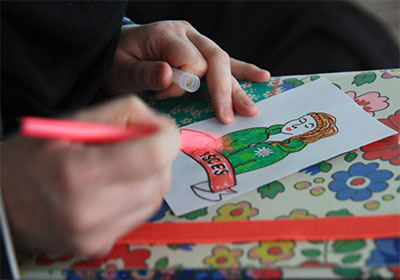
Mediation experiment based on the comic “Astrological Sign as Classic Queer Haircuts” by Shelby Criswell
Hybrid-Seminar (MA), Institute for Art / Art Education, University Osnabrück, winter term 2022/23
This edition of the seminar "Didactic Research: Becoming Funny. Humor, Difference, Criticism" at the University of Osnabrück was based on previous courses and my research on the topic. The seminar is based on a selection of artistic works as well as scientific texts. These starting points combine positions critical of power with different forms of humor. This time, the material was selected with a focus on queer and intersectional topics in art, music and comics as well as in art didactics. Productions by Sabian Baumann, Alison Bechdel, Shelby Criswell, Guerilla Girls, Jakob Lena Knebl and Ashley Hans Scheirl, Breena Nuñez, Karl-Josef Pazzini and Lil Nas X were intensively adapted and transformed into mediation experiments. Each participant kept a humor diary accompanying the seminar, from which selected excerpts were recited in individual sessions.
After a few online sessions with exercises, readings and workshop times, a block seminar took place in Osnabrück. On the first day we met at the university, on the second day we were working in the Kunsthalle Osnabrück. Through the offers of interaction and the alternation between individual and group phases as part of the mediation experiments, which were usually led by two students, there were various moments to show oneself personally and to get to know each other. The space for conversations and listening had a trust-building effect, so that the questioning of familiar pedagogical forms was also met openly and the students felt encouraged and cheerful in the end.
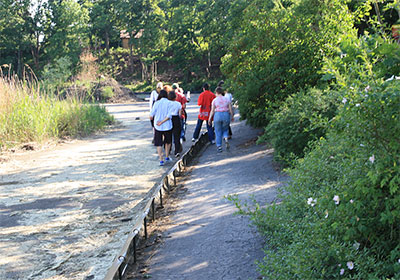
Taking a Walk with Text at the "Floating University"
Seminar at the "Floating University" with Prof. Dr. Maren Hartmann, Studium Generale, UdK Berlin, summer term 2022
This teaching cooperation with Prof. Dr. Maren Hartmann was based on a common interest in the genre of autosociobiography, i.e. in biographical texts that embed life stories in social contexts. The first examples of this were written by Didier Eribon, Annie Ernaux and Edouard Louis. The offer in the Studium Generale addressed students from different faculties. The venue for the seminar meetings was the Floating University, a rainwater basin near Tempelhofer Feld that has been converted into a laboratory for urban experiments. In addition to reading and discussing selected books, the focus was on writing memory works themselves. Classism as a relatively new or rediscovered form of discrimination was viewed from various intersectional perspectives.
With a visit to the theatre, a "book market" and discussions while walking (see illustration), the time flew by in this place with a communal kitchen. At the last meeting, we took up an idea from Eva Blome, who investigated, among other things, the role of photographs in autosociobiographical narratives. We each brought a personal photo with us, which we discussed in its social context, trying to interrupt schemes and prejudices.
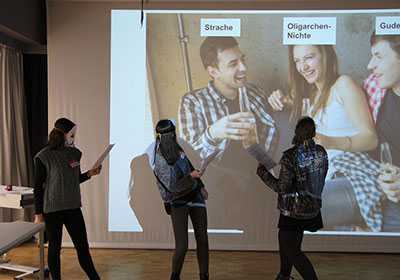
Role-play with memes by Nina Wöhrmeyer and Alexa Rosemann on a text by Schmidt/Lingg (2020) about the Ibiza scandal in 2019, which manoeuvred the austrian government into a crisis.
Didactic Research: Becoming funny. Humor,
Difference, Critique
Hybrid Seminar (MA)
Visiting teacher at the Institute for Art/Art Education, University of
Osnabrück, winter term 2021/22
The seminar entitled „Komisch-werden" (Becoming funny) took
place in winter 2020/21 under pandemic conditions. At the centre of the
seminar was the realisation of pedagogical units, each of which was prepared
in pairs and for each of which a comically humorous artistic or scientific
position formed the starting point. Since the materials available for
departure deal with comedy/humor and with social inequalities,
the students worked on and reflected the field of tension
between serious topics and humorous approaches. With the help of a presentation
on research questions and concepts, further steps to art didactic research
were developed.
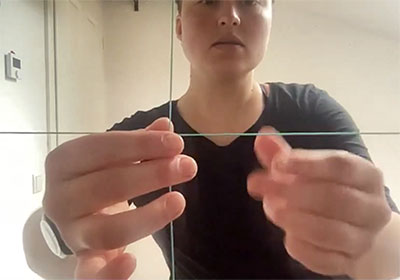
Performative intervention by Marie Salcedo Horn on questions of positioning oneself to a photo by Kazuyoshi Usui (2003)
Hybrid Seminar (MA)
Institute for Art Didactics and Aesthetic Education, UdK Berlin, and presentation on the festival „Room for Diversity!?", summer term 2021
A group of students to become art teachers gave insights into their preoccupation with the boundaries of mediation at the festival „Room for Diversity!? - Alliances between Art and Education Critical of Discrimination". These boundaries initially referred to artistic works that irritate through cultural or political references or evoke uncomfortable questions. Beyond that, it was about exploring personal boundaries: What art can and do I want to teach in school? How and to whom can I do this? And how can I proceed in a way that is critical of discrimination and reflective of difference? What should the framework conditions look like?
The interim results were presented online in the form of experimental lectures (cf. img.) and short videos and discussed with the audience. The aim was to exchange views and action spaces of discrimination-critical art and pedagogy and to advance awareness about them.
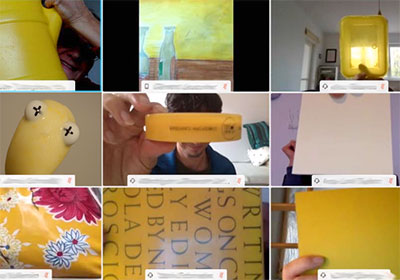
Monitor color game to warm up
Introduction to Art Didactics, Q-Master
Online-Seminar (Q-MA)
Institute for Art Didactics and Aesthetic Education, UdK Berlin, winter
semester 2020/21
The introduction to art didactics for Q-
Master students, i.e. those who intend to pursue a teaching qualification
after studying art, was conducted for the first time as a weekly video
conference.
In this basic course, art didactic theories and practical examples were
presented. Reading groups were formed to prepare the texts that were the
common thread of the sessions. Each group discussed the respective text
and decided on a question to ask about the text. These questions enriched
the presentation and the plenary discussion. Some playful elements interrupted
the focused online work (see fig. left). In addition, students each produced
a video and a collage that audiovisually translated public speaking about
art and the concept of unlearning.
During the semester, artist and arts educator Markus Strieder and Diversity
Arts Culture Director Sandrine Micossé-Aikins presented their work
in arts education.
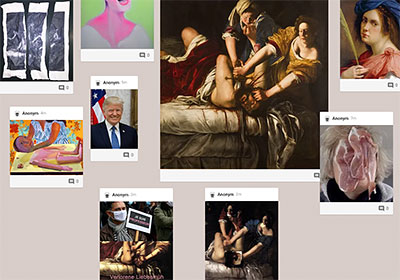
Mediation experiment departing from Sturm and Gentileschi, led by Silke Wittig and Vitalij Frese
Accompanying seminar internship semester for Q-Master, Online-Seminar (Q-MA), Institute for Art Didactics and Aesthetic Education, UdK Berlin, winter semester 2020/21
This seminar accompanies the internship
semester in the postgraduate teaching master for artists. In winter 20/21
it took place every two weeks online and in cooperation with the artist
and teacher Kathrin Sohn.
Central components of the accompanying seminar are practical-theoretical
units on unlearning privilege and learning non-discriminatory interaction.
The units aim at the further development of professional and pedagogical
skills.
Experimental text mediations and exercises support the positioning as
art educator(s) and the work in the internship semester. Practice-related
productions consisting of observation logs, documentation of own art teaching
practice, and alternative teaching and learning materials form the basis
of the portfolios to be created.
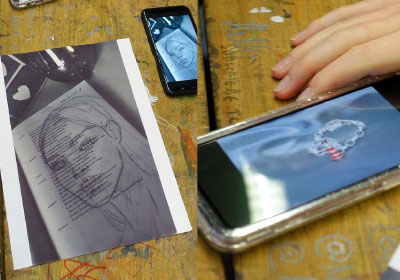
Pupils' work
Media / Body / Knowledge
Seminar (MA), Institute for Art and Art Studies, University of Duisburg-Essen,
WiSe 2019/20
Today, corporeality and media practices
are perceived as closely intertwined. Bodies extend digital media and
vice versa, or, as Heidrun Allert and Michael Asmussen put it, "We
cannot step out of the culture of digitality" (2017: 28, translation:
nl). In view of this difficult-to-penetrate connection of different materialities
and techniques, contemporary artistic perspectives offer a space to reflect
on (one's own) approach to this interrelation. In the seminar, we used
three foundational texts to develop differentially reflexive perspectives
on medial representation.
After getting to know the cooperating class at the Gesamtschule Essen-Borbeck,
the students developed three didactic concepts: one dealt with factual
photography, a second with collage, and a third with portraits of friends.
The pupils could choose one of three working groups. The students thus
led the photography project consisting of these three offerings in the
subject of art.
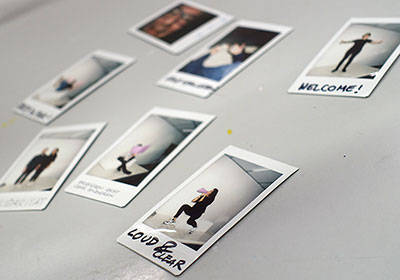
Visual statements in the context of a mediation experiment based on Carrie Mae Weems, moderated by Fabian Gründler and Moritz Kexel
Becoming Funny. Humor, Difference, Critique.
Seminar (MA)
Institute for Art and Art Studies, University of Duisburg-Essen, WiSe
2018/19
Based on artistic works, practical exercises and some texts, this seminar
dealt with humorous art from social critical perspectives. The combination
of humor and social criticism is no coincidence, because the preferred
point of attack of jokes are often the supposed weak points of others.
Thus, sexualization, ethnicization and other pejorative attitudes towards
certain groups of people - generally speaking, the principle of 'othering'
- are central building blocks of the regimes of the ridiculous. Minoritized
students and teachers in particular experience this at school. As countermeasures,
laughing back or redirecting attention to supposedly normal circumstances
are conceivable.
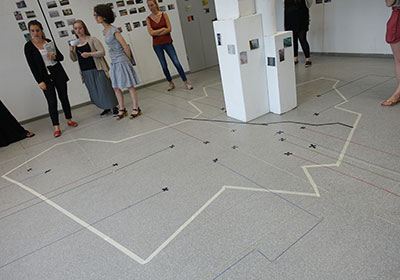
Presentation of a photographic research on graffiti in Essen
Research approaches.
Seminar (BA)
Institute for Art and Art Studies, University of Duisburg-Essen, Summer
Semester 2018
Participants formed research teams and each team developed a concept for
a field research project that was feasible during the semester. Starting
points were aesthetic phenomena and practices of children or young people.
The teams decided on a specific field in a pedagogical or everyday aesthetic
practice context they wanted to observe, furthermore on documentation
methods and a question they wanted to ask to the collected material. They
wrote memos during the collaborative research process and referred to
theories of empirical social research and art didactics. Artistic forms
of data collection and presentation were also explored, such as in the
spatial arrangement of a photographic research on the occurrence of graffiti
in all of Essen's neighborhoods (see image left).
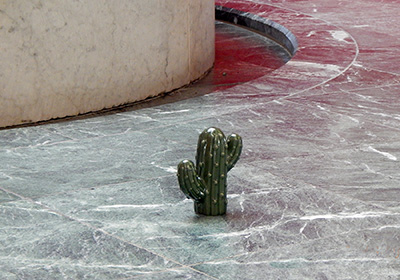
Temporary installation in the Folkwang Museum Essen during a lab session
Lecture and laboratory (BA)
Institute of Art and Art Science, University of Duisburg-Essen, winter semester 2018/19
The interactive lecture " Foundations of Art Didactics" regularly provides an insight into important lines of development in art education and approaches to subject didactics. Using exemplary texts, argumentation, structure and the context of theoretical statements are analyzed and discussed. Practical examples are placed in theoretical contexts. Theory is tested in practice. Questions of (one's own) aesthetic socialization will be linked to questions of "natio-ethno-cultural orders of belonging" (Mecheril). Accordingly, the course deals with current paradigms such as that of "unlearning" (Spivak) as well as with the role of media in educational processes.
The goal is to learn to navigate this field of theory and practice in order to subsequently be able to justify differentiated art pedagogical decisions that enable playful or experimental, speaking and researching engagement with art and everyday aesthetics.
The laboratory for art education and art mediation, which was taught together with Dr. Sabine Sutter, is a workshop in which the view of the framework conditions of, for example, museum presentations of art is practiced together. Here, the participants make their own observations and develop perspectives on art that provide a basis for art instruction.
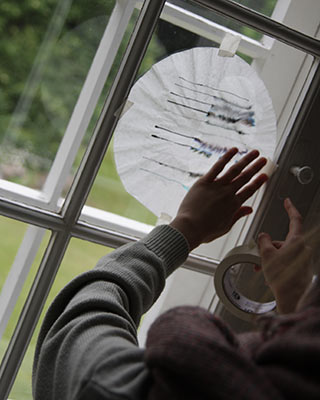
Testing the water resistance of pens to clarify the notion of the experiment
Art-Knowledge-Complex.
Seminar & Excursion (MA)
Berlin University of the Arts in cooperation with Prof. Dr. Linda Hentschel,
Mainz University of the Arts, SoSe 2017
Artistic research and learning is a controversial topic. During this residency,
the seminar group explored the possibilities of art-based research through
various observations, exercises, media and texts.
The question was raised how, from the perspective of the participants,
a hegemony-critical, ironic and deconstructive artistic research and learning
could look like. Experimental responses to this were designed, tested,
performed, and debated.
The diverse experiences of students from the two participating art schools
allowed for a multifaceted exchange and analysis of institutional framings
as well as their associated understandings of art and knowledge.
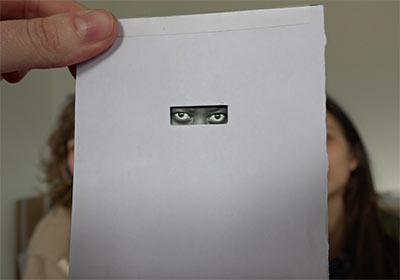
Video exercise with a portrait of Zanele Muholi
Gender and Art/Eduction.
Seminar for international students in the course "Trans-Masters",
Haute École d´Art et de Design Genève, Geneva, March
2017
With the help of two publications - Sara Ahmed's Feminist Killjoys
(And Other Willful Subjects) (2010) and Kate Bornstein's My Gender
Workbook (1998) - fundamental questions about gender and sexuality
were discussed intersectionally and related to the students' own artistic
or pedagogical practice.
An audio collage and a pool of images supported
the sensitization to one's own boundaries and ideas for the mediation
of gendered knowledge "from art." Concepts for mediation were
imagined together and tested inside and outside the university. These
tests were documented (cf. the image on the left) and finally presented
for discussion.
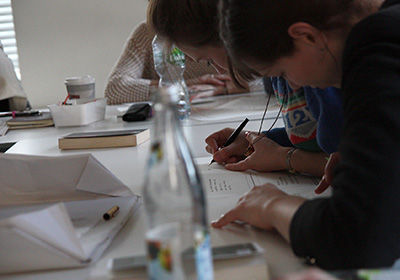
Assignments along timed worksheets inspired by Hanne Darboven's way of working
Based on artistic works and art pedagogical as well as cultural studies texts, this seminar dealt with time in art and art education.
With changing media (photography, writing, drawing, video), personal, cultural or political perceptions of time were to be captured and released. Furthermore, it was planned to sketch, test and reflect on ideas for teaching or pedagogical projects from the art and theory under consideration.
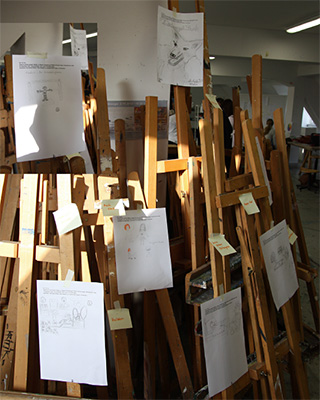
Collection of children's book memories at the beginning of the lecture
Art Education/Aesthetic Education for
Primary Level
Lecture (BA)
Department of Teacher training and art-didactic research, University of
Potsdam, WiSe 2016/17
This basic course outlined important
issues in art education and current approaches in subject didactics. For
example, it dealt with approaches to art when teaching in elementary school
as well as the role of media such as collage, photography, sound, animated
film, video and drawing in educational processes. In this context, concepts
such as competence orientation or inclusion were dealt with in an application-oriented
manner.
Throughout, questions about aesthetic preferences and habits were linked
to those about gender, origin, and other cultural differences that already
shape language and behavior in kindergarten.
Forms of participation were discussed using examples of art instruction
or art reception with children/students. Contemporary art pedagogical
strategies such as mapping or field research were tested in interactive
units and deposited with contemporary theory and practice.
The introduction aims to address the issues of perception, communication,
planning and positioning in educational settings and to provide a basis
for developing one's own ideas for differentiated, quality art instruction.
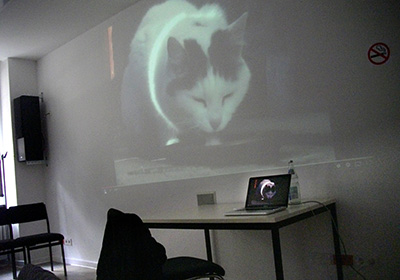
Performative setting with Büsi AKA Kitty (2001) by Fischli & Weiss to a text by Elke Krasny (2009)
Seminar (BA)
Institute for Art Didactics and Aesthetic Education, UdK Berlin, summer semester 2014
Looking at artistic works and texts from different disciplines, the interface between artistic and didactic research was considered. Relevant terms here are 'artistic research', 'research-based learning' or 'researching teachers'. The seminar started from positions of contemporary art and the forms of research negotiated therein. This includes lecture performances and artistic works that deal with questions of education by means of statistics, interviews or protocols.
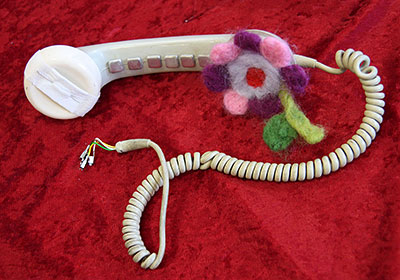
Pupils' work from a lesson by Claudius Hausl on three-dimensional collages
Seminar (BA)
Institute for Art Didactics and Aesthetic Education, UdK Berlin, winter semester 2013/14
The art of collage was a good 100 years old in 2013.
In this seminar, collage as a critical, pedagogical process was discussed and tested against this background. For this purpose, the students selected artistic references from a pool of relevant works. These works formed the basis for pedagogical and craft exercises (digital and analogue, individual and collective). In addition, two thematic issues of "Kunst + Unterricht" (Art + Teaching") played a role as well as theories on disobedient seeing (Judith Butler) and collage as a critical pedagogical medium (Wolfgang Kunde).
After the course, there was an opportunity for interested students to voluntarily conduct a collage lesson for primary school pupils. Two students took the opportunity and the school class experimented with three-dimensional collages, among other things (see img.).
