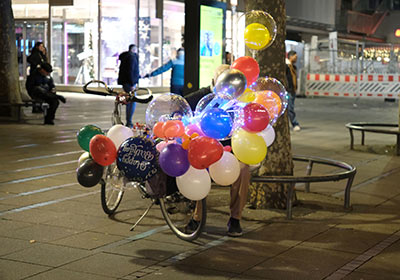
Balloons at night
Perspectives in the plural! Art Lessons as a Space for Democracy Education.
Art Education Symposium Berlin 2025, 28th November 2025
How can art teachers courageously face the complex situations in heterogeneous teaching-learning settings? The Art Education Day opens up spaces for exchange, playful action. After a theoretical input there are parallel workshops with artists and cultural workers on offer. The participants are invited to try out, reflect and further develop approaches to artistic democracy education and acceptance of diversity in the classroom in collegial exchange.
With an introduction by Ursula Jenni, UdK Berlin.
Plus Workshops by Ursula Jenni, Siska, Julia Schneider/Doc J Snyder and Antje Winkler, Sonya Schönberger and Silke Wittig, Patricia Vester.
Concept: BdK Berlin, Klein, Lüth, Winkler, Wittig,
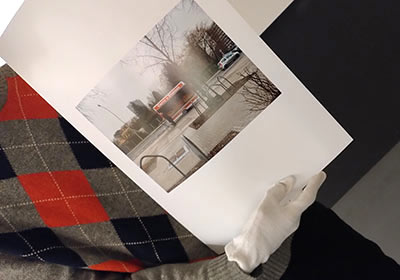
Preparing the Pictures for the Wxhibition (Photo: Alexander Di Vasos)
030 - multifaceted.
Photography exhibition of the Q2 art course of the Otto-Nagel-Gymnasium in cooperation with the seminar "Differential Reflexive Photography with Pupils", February 13, 2025
As a ceremonial conclusion of the collaboration of 21 students, 17 students of the ISS/Gym art teacher training program and two educators (Alexander Di Vasos and Nanna Lüth), the photography exhibition "030 - multifaceted" was presented in the main building of the UdK Berlin.
An important starting point for the study of contemporary photography was the joint visit to the exhibition "Dream On – Berlin, the 90s" at c/o Berlin in December. Subsequently, in strongly dialogically oriented lessons, photo series of the ppupils were discussed, which tell of life in the city, of uncontrolled growth and building ruins or document the parties, concerts and encounters with friends. In addition, a more precise perception was the topic and goal of the cooperation.
Poster motif "Interpreting the present. Claiming reciprocity. Art and Science as Media of Civil Society."
Interpreting the present. Claiming reciprocity. Art and Science as Media of Civil Society.
Hybrid Seminar with guests in cooperation with Prof. Dr. Konstanze Schütze, PH Karlsruhe, summer term 2025
The "Seminar with Guests" format was tested at the Berlin University of the Arts in the summer semester of 2023. A year later, the focus was on updating the debates on nationalist and biologistic-suprematist ideologies and the claim of reciprocity, which is fundamental to democratic action. The appointments with guests from the worlds of art, science and education took place in Berlin and Karlsruhe and were broadcast online for the seminar at each other location and for the interested public.
The guests were: Prof. Dr. Natasha A. Kelly; Anna Schürch; Yelena Yeremeeva, Rina Soloveitchik, Anna Schapiro (Ministry of Compassion); Hamze Bytyci, Joy Kristin Kalu and Sabine Rollberg; Patrice Poutrus; Fabian Bechtle and Leon Kahane (Forum for Democratic Culture and Contemporary Art); Mely Kiyak.
The series was supported by the Studium Generale, the Institute for Art Didactics and Aesthetic Education, the Institute for Art Didactics and Aesthetic Education, the Institute for Art in Context, all UdK Berlin, as well as the Berlin State Association of the BDK – Professional Association for Art Education.
Poster motif "Art / Education in National Socialism"
Art / Education in National Socialism. Retrospect, continuities, perspectives, Seminar with guests, UdK Berlin, summer term 2023
To date, there has been no coherent research on the predecessor institution of the Berlin University of the Arts, where art education could be studied during the Nazi era: the Staatliche Kunstschule zu Berlin (1918–1935), which was renamed the State University of Art Education in 1936 and existed under this name until 1945. The consideration of this historical turning point and its institutions and actors is therefore still pending from a professional and political perspective. The event series "Art / Education in National Socialism. Retrospect, Continuities, Perspectives“ dealt with continuities of ideologies, personnel and aesthetic practices, with gaps in research and information, as well as with post-Nazi perspectives on history and the present.
It was intended to give students and other interested parties the opportunity to get to know factual, contextual and methodological knowledge from artistic and scientific perspectives and to discuss the different forms of working and commenting of the invited guests.
The following guests took part: Fabian Bechtle and Leon Kahane (Forum for Democratic Culture and Contemporary Art), Yishay Garbasz, Alexander Henschel, Elke Krasny, Benjamin Ortmeyer, Brigitte Zuber.
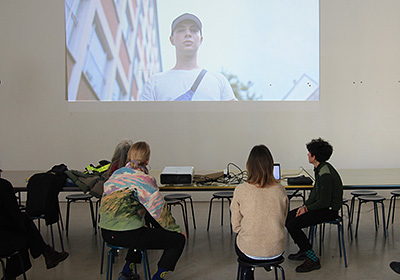
Workshop "Education Criticizing Anti-Semitism through Art" with Julia Yael Alfandari, November 19, 2022; Still film from: Arkadij Khaet and Mickey Paatzsch: Masel Tov Cocktail, 2020
Difference-Reflective (Art) Teaching Workshop.
Conception and organization of the series for the BDK Berlin e.V. Professional Association for Art Education, since 2022
In 2022, the Difference-Reflective (Art) Teaching Workshop of the Berlin State Association for Art Education was launched. Here, differential reflexive variants of art teaching or mediation are presented and tried out together, i.e. variants that deal with constructions of difference and their effects, which can be changed through pedagogical action.
So far, five events have taken place:
The kick-off was called "Paradise Camp* Contemporary Perspectives on Gauguin" with Stefan Bast, Nanna Lüth and Nhu Y Linda Nguyen in June 2022. Visiting the exhibition „Paul Gauguin – Why Are You Angry?“ focused on individual works and rooms of the comprehensive retrospective at the Alte Nationalgalerie. The participants then produced audio recordings that critically referenced the stereotypes shown in the exhibition.
In November 2022, the training course "Education Criticizing Anti-Semitism through Art" took place at Haus Bastian – Center for Cultural Education. With a view to the long history of anti-semitism and racism in Germany, which has an impact on the present, Julia Yael Alfandari conveyed how the strengths of art can be used in educational contexts to question and displace discriminatory patterns of thought and action.
In June 2023, Wibke Joswig and Leila Raabe led the workshop "Critique of Orientalism and Mediation of Difference" in the collection of the Alte Nationalgalerie. After a theoretical input, the participants dealt with interpretations of so-called oriental paintings on the basis of task sheets.
"Hey, what's so funny about that? A difference-reflexive teaching workshop on humor and aesthetic education" with the theater pedagogue Ömer Bayram as well as the "Working Group on „Antisicriminatory Art Education" at the annual meeting of the Federal Association of Art Educators in Saarbrücken took place in April 2024.
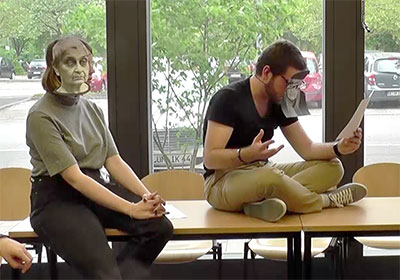
Reading Spivak
un-learning from... Anti-discriminatory perspectives on media practice by and with children and young people.
Event series and seminar (BA), Institute of Art and Art Studies, University of Duisburg-Essen, summer tern 2019
The postcolonial theorist Gayatri Spivak has coined the term un-learning, which she considers necessary for non-violent education. For this, she takes a look at the distinction between recognized and supposedly worthless knowledge. Spivak wants to stimulate the unlearning of traditional hierarchies and to work against the conventional ignorance of minoritized knowledge.
The department of art didactics/pedagogy at the University of Duisburg-Essen, with the support of the initiative ProViel - Professionalization for Diversity, realized a lecture series in 2019 with the title "un-learning from ... anti-discriminatory perspectives on media practice by and with children and young people". The speakers came from different places and practices. They spoke about aesthetic interests and cultural practices of children and young people from multiple disciplines and discrimination-critical perspectives. The range of media addressed included children's books, video, theater, dance, and social media.
The event was part of the course offerings for BA teaching students in art. The students were actively involved in the preparation and implementation of the lectures and workshops, for example through their own moderation, observation or contributions to the discussion.
Concept: Prof. Dr. Nanna Lüth, Dr. Sabine Sutter.
Titles of the contributions, names and short biographies (in german): https://un-learning-from.tumblr.com
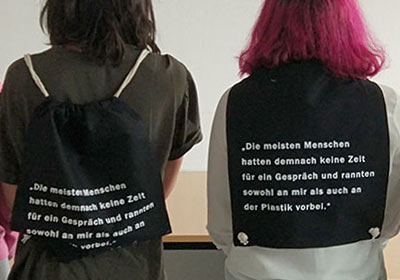
Final meeting with multiple (Photo: B. Trewin)
Video installation in the context of the RESULTATE exhibition, University of Duisburg-Essen, May 2019
Based on the one-minute videos on the assignment "Talking about Art" that students in the art teaching program and art studies had made in the winter semester 18/19, a working group of students developed a video presentation with the staff of the art didactics department - Dr. Sabine Sutter, Bernadette Trewin and me.
Thirteen videos were shown together with excerpts from the corresponding reflection texts in the annual RESULTATE exhibition of the Institute for Art and Art Science on the Essen campus. As a memento, the members of the working group each received a cloth bag printed with a selected quotation.
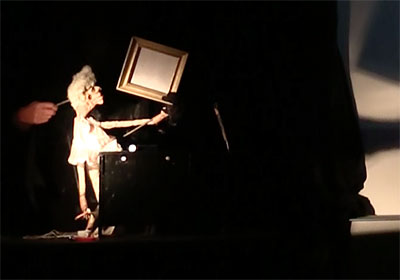
The Countess on art education - then and now (Video: Ü. Igde)
Event and get-together, UdK Berlin, July 2017
Prof. Dr. Paul Mecheril opened the event with a lecture on Heart Education. Explorations in Migration Pedagogy.
This was followed by short lectures with the Berlin authors of vorausgesetzt. Kunst/Pädagogik und ihre Bedingungen (Presupposed. Art/Pedagogy and its Conditions): Danja Erni, Ellen Kobe, Anja Kraus, Christoph Prasch, Eva Sturm, Wiebke Trunk.: Danja Erni, Ellen Kobe, Anja Kraus, Christoph Prasch, Eva Sturm, Wiebke Trunk.
In the evening, student videos on the topic of "Talking about Art" were presented by the Countess, Stuttgart's chain-smoking cult figure. In the process, her through-smoking, played by Stefanie Oberhoff, tried out radical forms of art mediation (see image, left).
With Videos by: Maik Dreyer, Johanna von den Driesch, Mania Godarzani, Katherine Léon Garcia, Celina Täge, Shuang Wu and others.
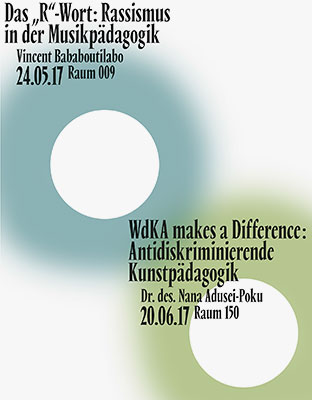
Poster "Power-critical pedagogies in the field of the arts"
Lecture series, UdK Berlin, summer semester 2017
The lecture series together with the colloquium *Power Critical Pedagogies in the Field of the Arts* comprised two dates: The first in May 2017 with musician, activist and teacher Vincent Bababoutilabo and the second in June 2017 with art theorist and educator Nana Adusei-Poku.
Bababoutilabo asked about the implications of historically developed racism for the music education field in Germany. In search of possible options for action, he reflected on excerpts from music pedagogical teaching-learning materials as well as concrete teaching situations from a perspective critical of racism.
Adusei-Poku presented the action research project WdKA makes a Difference, which investigated decolonizing approaches in the Willem De Kooning Academy (WdKA). The project included monthly readings and discussions with teachers, an exhibition with symposia, film screenings, and other initiatives and collaborations.
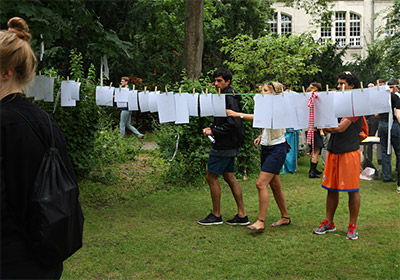
Visitors of the drawing exhibition
The
"Markup Shop". Exhibition
and action in the Ruin Garden on the occasion of the UdK Rundgang, Berlin
2015
The seminar "Access to the Rundgang" took a look at the annual
exhibition of the Berlin University of the Arts as an occasion for communication.
The aim was to develop mediation concepts in order to deepen the engagement
with the exhibited art during the "Rundgang" (annual exhibition)
in person or by means of media.
When the seminar met again three weeks before the exhibition, the wind
had changed: the students of fine arts had made a strong case for the
difficult working conditions of substitute professors. Until then, they
had only been paid during the semester, so that no supervision could be
expected from them over the summer. The added dissatisfaction with the
slowness of the appointments had given rise to the plan to strike the
summer exhibition.
While the decision-making processes in the various artistic classes were
still underway, the vision of a public action emerged in the "Accesses"
seminar: visitors to the tour were to be asked to think of and draw ideal
professors for certain artistic areas. The action was also to be used
to offer external guests an insight into the functioning of the faculty.
The drawings were exhibited in the garden; at the end some of them were
awarded with the help of a wheel of fortune.
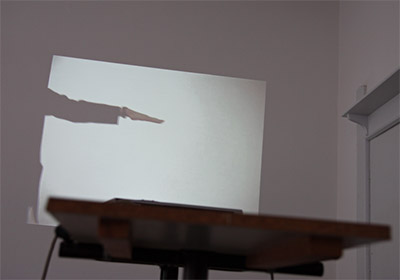
Snapshot during the lecture by Ellen Kobe
Presupposed. Art/Pedagogy
and its Conditions.
Lecture series, UdK Berlin, summer semester 2015
In the summer semester 2015, the series presented six positions working
at the intersection of artistic and pedagogical practice. All events dealt
with the question under which social or political conditions the described
perspectives of teachers, researchers, and artists become possible, but
also which ones they themselves produce.
Two years later,
the book on the series (in german language) was published.
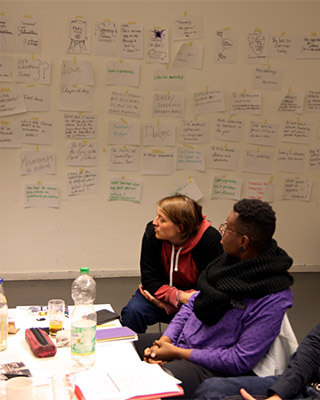
Participants of the first workshop in front of the cluster wall
Queering Art Education.Art/Pedagogy
to shift dominant orders of belonging. Workshops with international
guests in cooperation with Institute for Art Education of the Zurich University
of the Arts, UdK Berlin 2014 & 2015
Queering Art Education is oriented towards
artistic and pedagogical positions that share the claim of being critical
of racism and sexism and at the same time structured in an anti-essentialist
way. It is thus about the educational use of art, which programmatically
deals with the shift of dominant orders of belonging (Paul Mecheril 2011).
Queering Art Education refers to formal education in schools and universities
as well as to non-formal contexts of education or further education. Appropriate
approaches can be conceived as part of school art classes, continuing
education for educators and artists, arts education at universities, and
cultural education, and thus take on different registers of language and
aesthetics.
At the end of 2014, guests from Berlin, Ecuador, Mexico, Canada, Switzerland,
Austria, and England met for the eponymous workshop at the UdK Berlin.
The two-day working meeting served to present and discuss each other's
practice and to formulate visions of queer artistic pedagogy or art and
its mediation.
One year later, the participants met again. At this meeting, institutional
and structural fields of action were increasingly discussed. Through a
fundamental discussion about hierarchies and difficulties of insufficient
funding, the role of white initiators and the hegemony of the English
language in relation to this workshop, a debate emerged that resulted
in a shift in the distribution of roles.
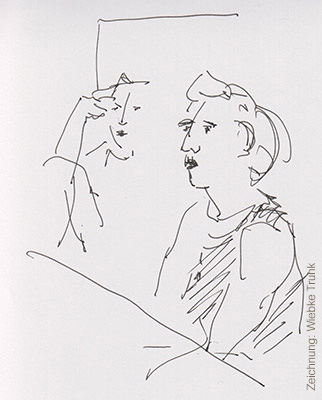
Sketch of the 7th Salon on July 3, 2015 in the transitional residence Marienfelder Allee of the International Federation Berlin-Brandenburg GmbH (drawing: W. Trunk)
Berlin 2012 – 2015
In 2012-15, the Salon für kritische Kunstvermittlung (Salon for Critical Art Education) organized seven events dedicated to the exploration of socially and institutionally critical positions in art education.
This series of events was realized independently of institutional ties and finances of the participating mediators (in different combinations Judith Boegner, Barbara Campaner, Anna Chrusciel, Nanna Lüth, Iver Ohm, Sandra Ortmann, Wiebke Trunk and Maren Ziese).
In this way, the mediators opened up a self-organized discursive free space at changing locations.
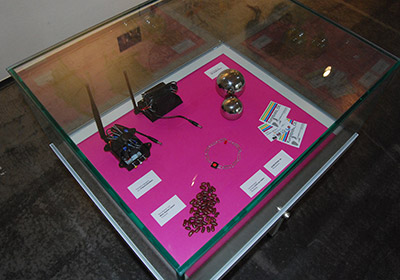
Display case with material and objects from various workshops
The Art of Mediation,
exhibition of the media art pedagogical work 2008/09 of the Edith Russ
Site for Media Art, Oldenburg 2010
The exhibition "The Art of Mediation" (January 18-24, 2010)
summarized two years of art education on the occasion of the tenth anniversary
of the Edith Russ Site for Media Art. The core of the exhibition was a
large picture wall of documentary photographs, loosely showing a chronology
of events. Two pedestals, a display case, and a free-hanging object were
arranged along the picture wall in a line that deliberately alluded to
a museum-like arrangement. Video productions from projects with different
age groups ran on four monitors.
The exhibition itself was communicated with the help of post-its, with
which visitors were invited to comment on the exhibits. In addition, an
evening was held with guests who presented their short films created in
workshops.
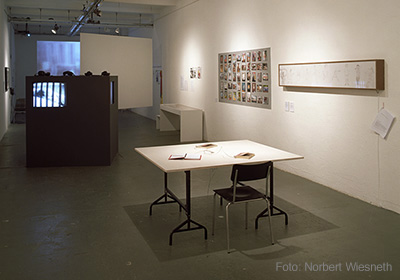
Exhibition view "Introducing Fascism and Nazism" (photo: N. Wiesneth), a participation project with Sanja Ivekovic (Zagreb) and Bojana Pejic (Belgrade/Berlin), Nanna Lüth, Christine Lohr and students of the Kantgymnasium (all Berlin)
pöpp68 – private, public, personal, political addressed and tested working forms of artistic participation in six collaborative projects, a conference and an exhibition.
The project pöpp68 brought together artists born in the 1960s (Seraphina Lenz, Nanna Lüth, Ulrike Solbrig, Rebekka Uhlig, Giuliano Vece, Jole Wilcke) with artists and theorists who were already active at that time (Claudia von Alemann, Kirsten Dufour, Rainer W. Ernst, Sanja Ivekovic & Bojana Pejic, Barbara Kleinitz, Christophe Kotányi). It enabled them to revisit together some of the complex thematic areas that defined political and social discourses of '68, such as fascism, body and power issues, gender politics, anti-authority and consumer critique. This took the form of participatory projects, research, and interventions. Thus, pöpp68 investigated participation opportunities and forms of resistance across generations from 1968 to the present.
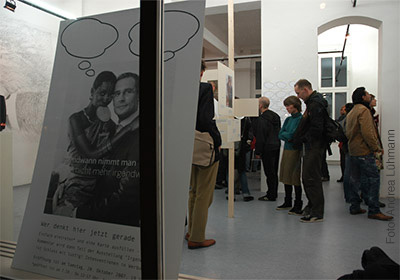
View of the exhibition (photo: A. Lühmann)
The starting point of the group exhibition was the advertising campaign for the magazine Hörzu. In the period from 2005 to 2006 couples like a pug and a cat, two young women kissing each other and a white man in a suit with a Black exoticized woman sitting on his lap were presented here under the motto "At some point you don't take just anything anymore" as an image for "very special" couples with high quality demands. The last image-text combination triggered a public debate in 2006. It was criticized by feminist, anti-racist and media-critical initiatives as discriminatory and inhuman.
The project At some point the fun is over! Interventions in Advertising at the art association arttransponder worked on sexist, racist and other disparaging approaches in current advertising images.
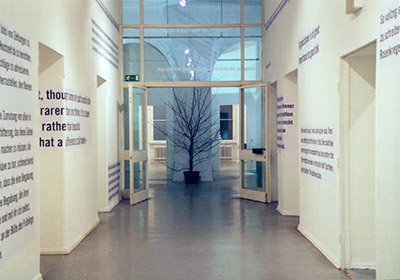
Exhibition design with quotes from Virginia Woolf (1929)
A room of one´s own was based on a collaboration between artists from Brussels and Berlin who explored Virginia Woolf's 1929 text that gave the exhibition its title in various media (painting, video, film, audio, installation). In this text, Woolf addresses the necessary cultural and social conditions for women's literary production: the "room to themselves," financial independence, and the self-confidence to write exactly what they think. She outlined an androgynous ideal with the idea that this would overcome the polarity of the sexes and release a maximum of artistic creativity.
The first exhibition of A room of one´s own took place in March 2006 at the cultural center De Markten in Brussels. In March 2007, the second edition with the programmatic claim More than a room of one's own was shown at Kunstraum Kreuzberg in Berlin. In the course of the exhibition, a film and event program took place in cooperation with the Arsenal cinema, the Ballhaus Naunynstraße and the Gendernet of the Berlin University of the Arts, in addition to concerts.
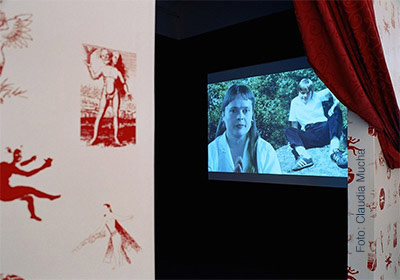
Exhibition view with the work of Roz Mortimer: Gender Trouble, 2002 (photo: C. Mucha)
1-0-1 [one ‘o one] intersex addressed the violation of human rights of hermaphrodites/ hermaphrodites/ intersexual people: Infants are still surgically adapted to normative ideas of male and female bodies. Intersexuality diagnoses are regularly concealed even in adulthood. Social acceptance of gender diversity that does not conform to normative expectations of a clear distinction according to two genders is low.
1-0-1 intersex called for further thinking across the two-gender system: Exhibition, archive, event series and a comprehensive catalog presented artistic positions, experiences and initiatives of intersexual people. Historical, scientific-critical and legal backgrounds were presented in order to initiate a broad discussion about gender boundaries and the treatment of intersexuality in Western societies.
